Archive for the ‘Shutters’ Category

 March 2nd, 2014 |
  Author:
 Stave Core Doors & Shutters
Most of the shutters and doors we make here at Kestrel, both interior and exterior, are built out of solid, kiln dried wood without the use of any laminates. We can do this as the wood species that we use, American Basswood and Sapele Mahogany, are dimensionally stable and react minimally to changes in humidity.
So what happens when you want doors or shutters made from a different species of wood that is not as stable? If we were to make our doors and shutters out of solid woods like Hard Maple, Birch, White Oak and Red Oak, while they would be beautiful they would also be likely to warp. Especially when made to the sizes of doors or larger windows.
This is where Stave Core enters the picture.
What is Stave Core?
When 2 or more pieces of wood are glued together the chance of warping drops dramatically. This is because if any of the boards try to warp they end up “fighting” against the other boards and are held straight. The only problem is that the glued up boards don’t look as nice as a single piece of wood. So, you take those glued up pieces of wood ( that are now very, very stable ) and glue a solid, but thinner, piece of wood to each face and to edges as well. This is what stave core is: Thin strips of wood, laminated together to make them extremely stable, then covered in pretty much any wood that you want.
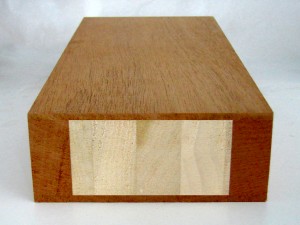
Mahogany stave core door stile
This photo shows a cross section of a Mahogany Stave Core door stile. The front and back faces of the door stile are 1/8″ thick Mahogany and the edges are 3/4″ thick Mahogany. These are wrapped around several smaller pieces of poplar. All of these are laminated together to make a super stable stile which ensures that the interior door made from these will remain straight.
What are the Benefits of Stave Core Doors
Stability. Using stave core for the stiles ( the vertical frame pieces of the doors ) will make sure that your doors will not move over time from changes in humidity.
Over-sized doors are not a problem. This ties in with stability but the idea is that by using stave core for the stiles, and even the rails, you can have doors that are much larger than normal.
Eco-friendly. Stave core is made up of smaller strips of wood that would otherwise have been discarded.
Lighter weight. The cores of our stave cores are made from Poplar or Pine which are both lighter in weight than the hardwoods used on the outside of the stave cores. This helps to keep the overall weight down.
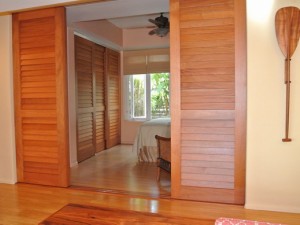
Fixed louver sliding doors made with Mahogany stave core stiles and rails
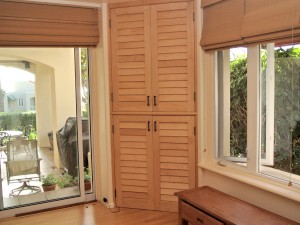
Maple doors, built with stave core, cover a corner media center in this Hawaiian home.
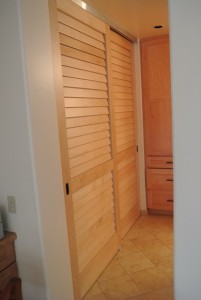
Fixed louver sliding closet doors made with Hard Maple stave core


If you would like an option for stave core doors just make a note of that in the comment section of our quote request form.
 Posted in Doors, Shutters |
  Tags: closet doors, interior doors, Interior Shutters, Stave Core, Woodworking |
  2 Comments »
Using Exterior Shutters & Doors on your Outdoor Living Space
Something that we have been seeing more of in the last couple of years has been the use of shutters and doors to create more usable living space. We see shutters and doors being used as windbreaks on decks and around pools, forming the walls of gazebos, cabanas, outdoor showers and even fully enclosing porches.
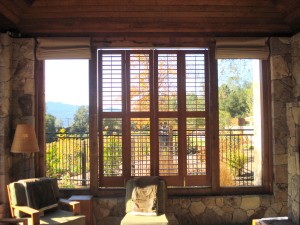
Here operable louver shutters are combined with roman shades to control the light on the porch lobby of this Dude Ranch.
Exterior Shutters as Windbreaks and Sun Screens
Louvered shutters, both operable and fixed, do an excellent job of blocking the wind and Sun. These are usually mounted with hinges or fixed in frames. Another common installation method is to make a simple wood frame with a groove to allow the louvered shutters to slide back and forth. The benefit of the hinges or slide are that you can easily move the shutters out of the way if you want an unobstructed view.
If you are looking to drastically reduce the amount of wind or sun consider alternating between louvered shutters and a solid style shutter like a raised panel or tongue & groove. Alternatively if you are looking to block the sun or wind in only a single place on your porch you can always create a mini frame to hold the shutters in that spot and leave the rest open.
Gazebos and Cabanas
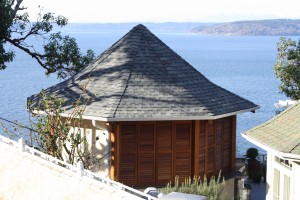
Plantation Shutters on a Gazebo overlooking Puget Sound
Just like louvered shutters can be used as windbreaks and sun screens on a porch they can be adapted to stand alone structures like gazebos and cabanas. There they can be used to create walls between the posts and roof supports and even provide security. If hinged they can be opened up to create “windows”. We often see louvered doors added to cabanas to provide privacy as a changing room or outdoor shower.
If only a little bit of ventilation is needed choose a style like our louver over tongue & groove. This gives the extra protection and sound insulation from the true tongue & groove boards while still providing some air flow.
Operable Louvers v.s. Fixed Louvers
- Operable louvers allow you to adjust how much of the wind and sun is blocked so that you can completely shut out the Sun, wind or rain and then open it up for more gentle breezes. If you have particularly strong winds you may need to attach a simple latch to keep the louvers open or closed during blustery days.
- Fixed louvers will deflect the Sun, wind and rain but still allow a steady flow of air. This is helpful where there is a concern for overheating and a need for constant circulation. Since the louvers are fixed these are best hinged or in sliding frames. That way they can be opened up when you want.
The best thing to do is to go where you plan to add exterior shutters and doors and think about what you want to block. Is it the sunlight, wind, your neighbors house or just the outdoors in general? Do you want to the shutters to cover the entire area or just a part? Will you want to be able to remove or open the shutters or do you prefer them to be fixed in place. Going through these questions will help to narrow down what will work best for your home. If you are still not sure what will work best give us a call, an email or use our online chat.
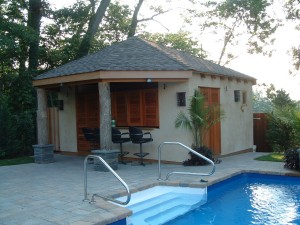 Exterior shutters enclose this pool-side bar and cabana. |
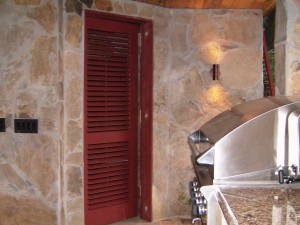 An operable louvered door is used to close of this outdoor changing room. |
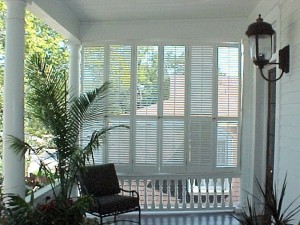 Operable louvered shutters act as a windbreak and privacy screen on this second story porch. |
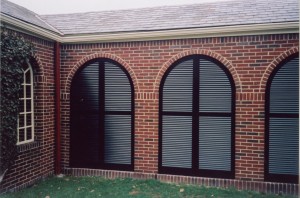 Arched, fixed louvered exterior shutters were used to block off one side of this breezeway between buildings. |
Posted in Exterior Doors, Exterior Shutters |
Tags: Cabana Doors, Cabana Shutters, Exterior Doors, Exterior Shutters, Pool House, Porches |
2 Comments »
Reproducing Exterior Shutters for Historic Homes
In the last 24 years we have reproduced many exterior shutters for many historic homes and buildings. While some shutter details were consistent to style or location of the homes others had feature that made them unique. When we look at an historic project there are certain things we need to consider.

What details on your Exterior Shutters need to be matched?
To begin with, almost any detail can be matched. We have matched custom cutouts, raised panel and louver profiles, stile and rail dimensions, shutter thickness, through-tenons, lead capping, horns and more.
As far as what details you NEED to have matched … this will vary as the answer depends on many factors including personal preference, historical requirements and even funding sources.
If your home is on the national registry of historic places you should check with your State Historic Preservation Officer. They can direct you to the information you need regarding reproductions. Local historical societies can also help and should be checked as they may have different requirements from the state.
If your home is not on the national registry then what is matched is really up to you. We have done homes where the new shutters matched every detail to nothing at all. Sometimes as long the shutters look appropriate to the home the preference is to go with a completely different style of shutter.
In other cases the cost of the exterior shutters is being covered by a government grant and everything needs to be matched. The arched shutters shown at left are a good example of that. The original shutters, from an octagon house built in the mid 1800’s, had been made an inch too short. Because of the source of the grant money we had to make sure that the new shutters were made an inch too short as well and then tack on a piece of wood at the bottom. We did offer to make them to the correct size but that was turned down as that was not how the original shutters had been made.
Matching the original Exterior Shutters
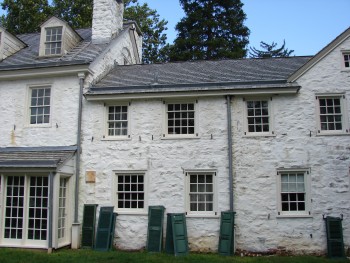
The General Maxwell Headquarters at Valley Forge national Park prior to Kestrel Exterior Shutter Restoration
Of course the thing that helps the most in matching older shutters is having the original shutters in the first place. Even if they are in poor condition we can still learn a lot. In some cases the originals were destroyed years back so no one really knows for sure what the exterior shutters looked like. For cases like this we rely on any old photos that the current owners have found. If they have no photos then the next places to turn to are the historical society and other local homes from the same time period. Since many of our exterior shutters designs are based on traditional styles our standards can usually blend right in with what is needed for a historically accurate home.
If the originals can be found the best thing is to send us a matched pair so that we can take accurate measurements. Even with the originals in hand it can be a bit tricky. Sometimes we find that the shutters had been trimmed down at some point to allow for new windows or storm windows being installed. Other times the shutters have started to fall apart and the only thing holding them together are the dozen or so paint jobs that have been applied over the years.
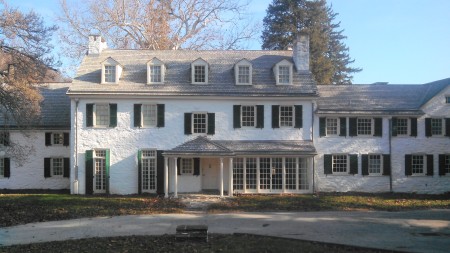
Kestrel Reproduction Exterior Shutters installed on The General Maxwell Headquarters at Valley Forge National Park
Even without the originals we can tell a lot from photographs. We may not be able to get minute details but we can still make sure that the overall look of the shutters will match what was once there.
The cost of reproduction exterior shutters
There is no way to guess at the pricing without seeing what we are matching. Since our exterior shutter specifications are based on historic designs, quite often there is no additional charge. Certain details, like matching the width of rails or stiles, are really just a one time setup cost. If you only need 1 or 2 shutters it may not be practical but when spread out over several shutters the setup costs are minor. Other features, like matching decorative trim or the shape of a raised panel, require special cutting knives to be made. Here again the price may be a bit prohibitive for only 1 or 2 shutters but reasonable for an entire house worth of shutters.
The best way to start with getting a quote is to send us a list of sizes, some photos or drawings and letting us know what you would like us to match.
We will probably go back and forth a few times to make sure that we are quoting you what you want. Then we will be able to send you some quotes, pricing out the different features as well as some options that will lower the cost.
Regardless of what you are looking for in the way of Exterior Shutters, give us a call or send us an email. We will be happy to work with you to make you what you want.
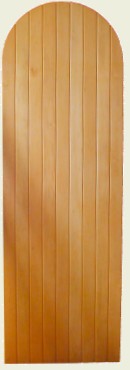
Arched Tongue & Groove Door
Tongue & Groove vs Beadboard for Shutters and Doors
While we are all familiar with flat and raised panel shutters and doors there are other choices when you are looking for something solid. Two popular alternatives are Beadboard and Tongue & Groove.
 Profile of Beadboard |
 Profile of Tongue & Groove |
Tongue & Groove
The name Tongue & Groove actually refers to the way the boards join together. If you look at the images above you will see how one end has a slot milled in to the wood (the “groove”) while the other end is milled so that part sticks out (the “tongue”). To join the the boards the “tongue” on one piece slides in to the “groove” on the next piece. The design we mill has chamfered edges that give it the look of a “V” where two boards meet up. The nice thing about Tongue & Groove is that it can be milled on to most any thickness of wood so that doors (like the one to the left) or board & batten shutters can be made without any frame.
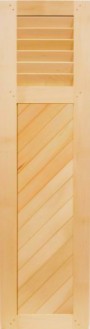
Door style 6162H with partial herringbone pattern
We also offer doors and shutters where the tongue & groove fits within a frame like our 6162H shown to the right. In this design instead of the tongue & groove running vertically we have it cut at an angle. This way when 2 shutters or doors are side by side they take on a Herrignbone pattern.
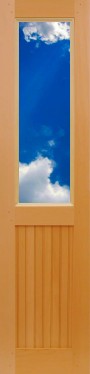
Style 6570 doors with Beadboard
Beadboard
Our Beadboard is really just a variation on Tongue & Groove. It uses the same joinery method, but instead of a “V” channel there is a 1/4″ diameter bead running vertically on each face of the wood. We tend to see more of the Beadboard design with cottage style homes where it is matched up to Beadboard paneling and wainscoting.
Boards vs Sheets
Something to point out is that our Beadboard and Tongue & Groove panels are double sides unlike most of what is available on the market today. Where the industry standard is to just mill a “V” channel or bead down the face of plywood we still prefer the more traditional method where each board is milled individually to give a more authentic look and feel.
If you are considering designs of exterior or interior doors and shutters that have Beadboard or Tongue & Groove, but are not sure which will work best for you please ask us. Give us a call, send us an email or start an online chat. We are happy to help.


Posted in Doors, Shutters |
Tags: Beadboard, closet doors, Exterior Shutters, interior doors, Interior Shutters, Tongue & Groove |
No Comments »
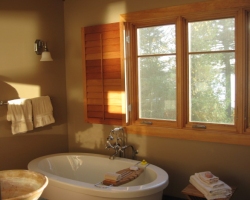
Spanish Cedar Shutters are ideal for a Bathroom
Using Wood Shutters and Doors in a Bathroom
When it comes to using wood shutters and doors in a bathroom there are a few things that you need to consider; privacy, ventilation and humidity.
Privacy
Privacy in a bathroom is obviously important to many people. Most styles of doors or shutters will offer some degree of privacy. Louvered Doors offer line of sight privacy while solid interior doors with raised or flat panels, tongue & groove or even frosted glass have the added benefit of sound insulation. For bathroom windows operable louvered shutters have always been a favorite. They can be adjusted to allow as much light in as you want or closed for privacy. How much and what type of privacy you want is up to you but can also depend on whether you need ventilation.
Ventilation
In some cases ventilation is required. If your bathroom has an air return for central air conditioning then you need to to have a bathroom door with ventilation so that when the door is closed the air condition functions properly. Check with your a/c service company to see how much air flow you will need. If you want a door that has privacy with a bit of ventilation you may want to consider some of our combination doors of tongue & grove with louvers.
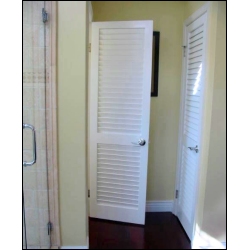
Louvered Doors for a Bathroom and Linen Closet
Humidity
If it is a full bathroom then you may need to contend with a build up of moisture from a shower as well as water spray landing on the shutters and doors. Having interior shutters and doors that are properly painted and maintained will help prevent any water damage. A better choice is to use wood shutters and doors that are made from Spanish Cedar which is what we use for our exterior shutters and doors. Yet another option is to go with our Faux Plantation Shutters which will not be affected at all by the moisture and also resists bacteria which could form in the bathroom.
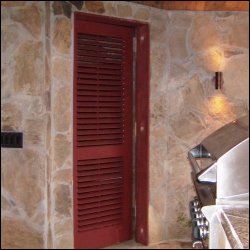
Operable Louvered Doors for an outdoor bathroom
If you are not sure which designs of interior doors or shutters will work best for you please ask us. Give us a call, send us an email or start an online chat. We are happy to help.
Posted in Doors, Interior Doors, Interior Shutters, Shutters |
Tags: bathroom doors, interior doors, Interior Shutters |
No Comments »

